San Francisco offers a wonderful series of free guided walking tours around many places of interest. We took this tour around the Castro (our local haunt) which for me was one of the many highlights of our visit.
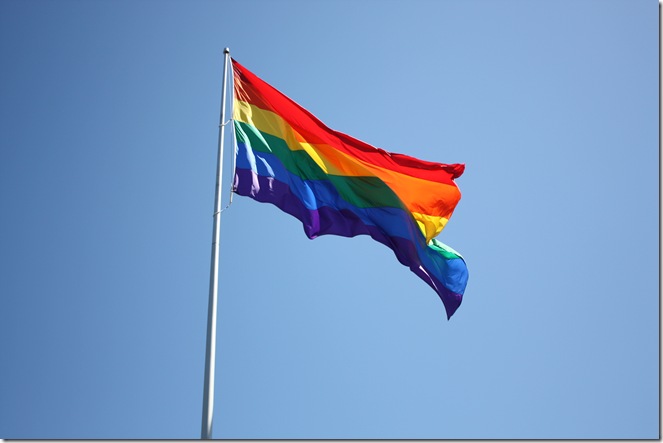
Appropriately, we met under the famous rainbow flag in the heart of the Castro.
The rainbow flag is an internationally recognised symbol representing lesbian, gay, bisexual and transgendered (LGBT) people throughout the world. This particular giant (there’s that word again) flag was installed here in 1997 to commemorate the 20th anniversary of the election of Harvey Milk to the San Francisco Board of Supervisors in 1977. Harvey was the first openly gay person to be elected to a San Francisco position of public office, and worked tirelessly and effectively for gay rights before he was tragically murdered in 1978. More about Harvey later.
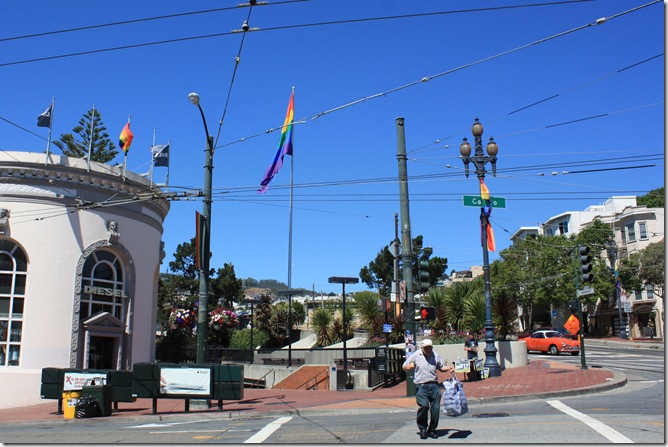
Here is the rainbow flag in situ, at Harvey Milk Plaza in the Castro, with a few other rainbow flags around it.

In fact, in the Castro, there are rainbow flags everywhere.
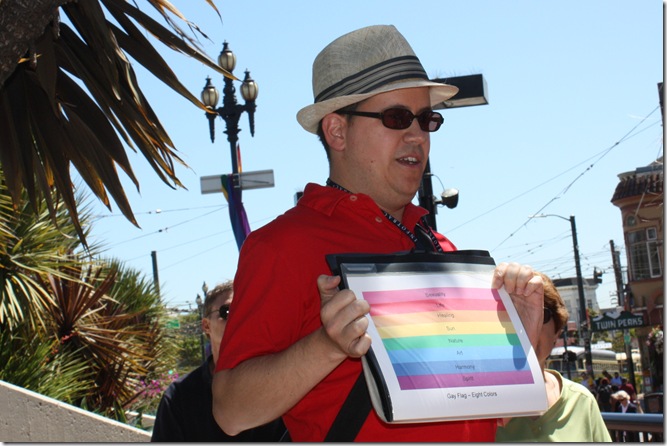
Our guide was Sean Timberlake, articulate, knowledgeable, witty and passionate about his local area.
He began our tour by giving a brief history of the Castro, and how it had become the gay-friendly community that it is today. Here he is explaining the development of the rainbow flag.

The original flag, designed by San Francisco artist Gilbert Baker in 1978, comprised eight colours, which represented sexuality, life, healing, sun, nature, art, harmony and spirit. After Harvey Milk’s assassination in 1978, demand for the rainbow flag greatly increased. To meet demand, the hot pink stripe was dropped because of the unavailability at that time of hot pink fabric.
In 1979 the flag was modified again. When hung vertically from the lamp posts of San Francisco's Market Street, the centre stripe was obscured by the post itself. Changing the flag design to one with an even number of stripes was the easiest way to rectify this, so the turquoise stripe was dropped, which resulted in the current six-stripe version of the flag.

Excerpts from this article in
The New Colonist sum up quite accurately the story of the Castro that Sean gave us:
While it may seem to all and sundry that the Castro has been Homo Heaven since the days of Adam and Steve, the area's transformation from a family values-type neighbourhood to Queer Central has been relatively recent. Up until the 1960s the district was better known as Eureka Valley, and was populated mainly by families of Irish and Italian descent. Then when the long-haired, tie-dyed bohemians of the Swinging Sixties took over the nearby Haight Ashbury, Castro residents who feared a similar influx decamped for suburbs in the Peninsula and the East Bay, leaving many of the old Victorians vacant. Soon, young gay men moved in, drawn by the area's charm and cheap rents (Yes, there was a time when rents in the Castro were actually inexpensive…) Within a few years, gay-owned and -operated restaurants, bars, and shops had opened, catering initially to locals, but soon discovered by the rest of the city.
The 1970s and early 1980s were for many the Castro's salad days. Increasing tolerance of alternative lifestyles brought a new spirit of exuberant openness. New establishments were opening left and right, catering to the flood of gay men and women who felt welcome here in a way they'd never been anywhere else. Crowds thronged the sidewalks day and night, and the Castro's fame as the centre of the gay universe slowly spread. Gay Pride celebrations and the Castro Street Fair both had their start during this heady period.
Within just a few short years, though, the party came to a crashing halt. By the mid-1980s, AIDS had taken its toll on many area residents. People who had spent much of their time throwing parties were all of a sudden organizing funerals for friends and loved ones. The Castro came to be seen not just as party central for the gay community but as a symbol of survival in the face of adversity.
By the time the 1990s rolled around, the Castro started to bounce back. A new generation of self-proclaimed young, loud, and proud gay men and women arrived to inject a new vitality into the area. The funereal atmosphere that had pervaded the area for quite some time began to lift, and the Castro once more became known as a hip, hopping place to be. Too hip and hopping, in fact, for some. Rents began to climb, chain stores threatened to enter, and conflict started to arise between those who felt the Castro was becoming too crowded and commercialized, and those who welcomed the entry of new faces, and the new influences (and finances) they brought.
Cut to today. Rents are still stratospheric. A chain store or two has popped up. And from time to time straight people (gasp!) actually come and enjoy the charms of the Castro. But the gay ole feel of the establishments, the diversity of the populace, and the general sense of community is something the neighbourhood retains in generous quantities.
From http://www.newcolonist.com/castro.html

The Castro Theatre, built in 1922 with a Spanish Colonial Baroque facade, was designated San Francisco Historic Landmark #100 in 1976. The shape of the roof line, the plaster wall decorations and the large windows are reminiscent of a Mexican cathedral, all combining to convey a look of grandeur in keeping with the large scale of many theatres built in the 1920s.
The International Lesbian and Gay Film Festival was currently in progress for Pride Week.

The large neon "Castro" sign, visible from much of the city, including Laura and Arend’s balcony and Kite Hill, is emblematic of both the theatre and the Castro District.

Spot the Castro Theatre from Laura and Arend’s balcony.

The interior is luxurious and ornate (so we are told – we didn’t get to go in), with a dramatic "Mighty Wurlitzer” pipe organ that is played before films and events.

Detail of Spanish Colonial Baroque lobby decoration.

…..and again.

Here’s the Castro Theatre taken from Kite Hill with my zoom lens. Isn’t it beautiful!

Cliff’s Variety Store celebrated its 75th birthday this year, and has been operated by the same family in all that time.
The first Cliff’s Variety Store opened in Castro Street in what was then Eureka Valley in 1936, and as it expanded has moved around various Castro Street locations. Its current location is the site of the original Castro Theatre built in 1910, which was remodelled into a retail store in the mid 1920's after the present larger Castro Theatre was built in 1922, as well as the building next door.
The store kept pace with the rapid changes which occurred in the neighbourhood during the 70's. Product lines were added and expanded to meet the needs of gay couples restoring their Victorians, and lines were also added to accommodate people putting their drag costumes together. So, you could get a plaster ceiling medallion, a feather boa, a toilet fill valve, a rhinestone tiara, and toys for the nieces and nephews all in one place!
Cliff's was the first straight-owned business on the block to hire openly gay employees. As the neighbourhood changed, so did the skills required of sales clerks. In addition to a knowledge of hardware, electrical, and plumbing, people were needed who could advise with decorating, costuming, cooking, sewing and entertaining.
There is Pat, just under the rainbow flag.
![]()
75 years of having it.
Ad for Cliff's in the Castro MUNI subway.

Castro Camera was a camera store in Castro Street operated by Harvey Milk from 1972 until his assassination in 1978. During the 1970s the store became the centre of the neighbourhood's growing gay community, as well as campaign headquarters for Milk's various campaigns for elected office.
Harvey Milk strongly believed that neighbourhoods promoted unity and a small-town experience, and that the Castro should provide services to all its residents. Within a month of being sworn in to the the San Francisco Board of Supervisors , he began to work on a city ordinance to require dog owners to scoop their pets' droppings. Dubbed the "pooper scooper law", its authorization was covered extensively by television and newspapers in San Francisco. Known as "a master at figuring out what would get him covered in the newspaper”, Harvey invited the press to Duboce Park to explain why the new law was necessary, and while cameras were rolling, stepped in the offending substance, seemingly by mistake. His staffers, however, knew he had been at the park for an hour before the press conference looking for the right place to walk in front of the cameras.
On November 27, 1978, Harvey Milk and Mayor George Moscone were assassinated by Dan White, another city supervisor who had recently resigned but wanted his job back. (He didn’t get it.)
In 2009, President Barack Obama posthumously awarded Milk the Presidential Medal of Freedom for his contribution to the gay rights movement stating "he fought discrimination with visionary courage and conviction".
Later in the year, California governor Arnold Schwarzenegger designated May 22 as “Harvey Milk Day”, and inducted Milk in the California Hall of Fame.
The plaque covering Milk's ashes reads, in part:
[Harvey Milk's] camera store and campaign headquarters at 575 Castro Street and his apartment upstairs were centers of community activism for a wide range of human rights, environmental, labor, and neighborhood issues. Harvey Milk's hard work and accomplishments on behalf of all
San Franciscans earned him widespread respect and support. His life is an inspiration to all people committed to equal opportunity and an end to bigotry.
Castro Camera is now a Human Rights Campaign centre.

Plaque to Harvey Milk on the footpath outside Harvey Milk’s former shop and residence. It reads:
HARVEY MILK: Forceful advocate for the rights of all. “Burst down those closet doors once and for all and stand up and start to fight.”

In 1974 Fred Rogers and David Manducca opened the Elephant Walk bar/restaurant which help to bring the emerging gay community together. In 1996, the bar was reopened as "Harvey's", in memory of Harvey Milk.

In 1996, the Douglass Elementary School was renamed the Harvey Milk Civil Rights Academy, which operates as a small alternative school in the Castro.
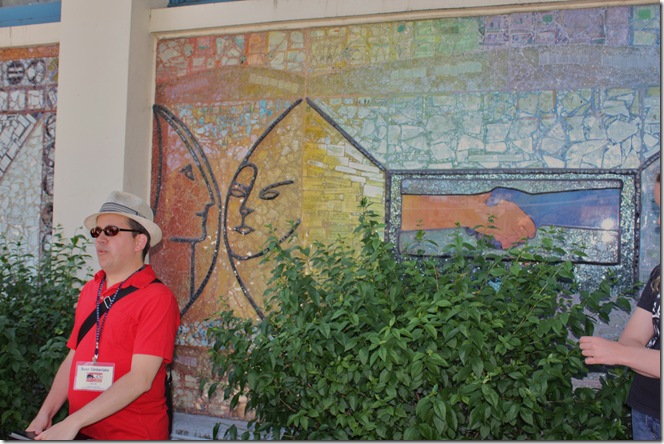
The school has a policy of tolerance, non-violence and celebration of diversity.

San Francisco is one of the best places in the United States to find examples of Victorian architecture – in fact there is more so-called Victorian architecture here than in any other area in the world.
Sean gave us an excellent run-down on the main variations of Victorian architecture here in the Castro – Queen Anne, Stick and Italianate – and Pat became quite an expert at identifying the different types on our many walks around (or should I say up and down) the neighbourhood.
To make it trickier, many houses are combinations of different styles, or have been modified over time.
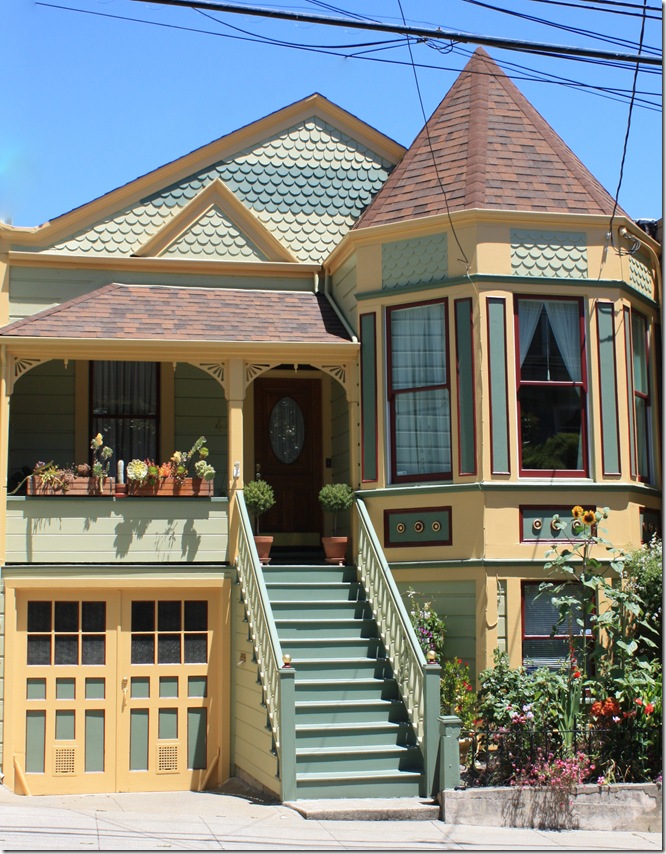
For example, I’m guessing that this house is primarily Queen Anne:
Queen Anne: The overall shape of the house is asymmetrical. They have a steep gabled roof, shingled insets, slanted bay windows, and often have a turret or tower. Flourishes include lots of gingerbread, spindles, ornate cornices, brackets, and lead or stained glass windows.

This house was for sale. Sean checked it out on his Smartphone and told us they were asking 1.6 million for it. I’m guessing the architecture is Stick.
Stick: This style includes square bay windows which let in more light than slanted bays, flat roof lines and free-style decorations, turned, square, or round columns.

The Most Holy Redeemer Catholic Church, built in 1901.
When the area’s blue-collar immigrant families began moving to newer neighbourhoods after World War II and single gay men trickled in, the Catholic church was hardly welcoming. Father Tony McGuire arrived in the early 1980s, preached tolerance and transformed the parish; some Castro residents dub Most Holy Redeemer “the gayest church west of the Vatican.”
We found it very welcoming when we later went to Mass there.
.

Our Castro tour concluded at Pink Triangle Park. It is the first memorial in America to the estimated 15,000 gay, lesbian, bisexual and transgendered people sent to Nazi death-camps in World War II.
The triangle theme recalls the Nazis forcing gay men to wear pink triangles (apex downwards) sewn to their clothes as an identifier and badge of shame. The pink triangle (apex now upwards) has been adopted as a symbol of hope for GLBT people.
Pink Triangle Park was created in 2003 by the Castro/Eureka Valley Neighbourhood Association, that says the park serves as "a physical reminder of how the persecution of any individual or single group of people damages all humanity."


