Friday, September 20, 2019

Kathy's family home, Tiernaur

Tuesday, 17th September, 2019.
Kathy was born in this house, which is where her mother grew up as well.  The house is now vacant, but owned by one of Kathy's sisters, and it is used by many of the family who visit from all over the world, mainly in the summer.

Originally, the only access to the house was across these stepping stones.  The river is fairly high now, so some of the stepping stones are under water.

Kathy gave me this picture of what the stepping stones looked like when the water was lower.  She said that when she lived in England and they came here on holidays, they used to lie on the stones and wash their hair in the flowing water.
Sounds a bit uncomfortable!


In 1938, Kathy's Uncle Patrick, with the help of a neighbour, built this bridge  to give better access to the house than that afforded by the stepping stones over the river.  Firstly, they diverted the river to one side, then to the other, then to both sides.  They completed the projects in only six weeks.  Kathy's Grandma spent the whole six weeks praying that there would be no rain, which would ruin the project.  There was no rain.
The bridge is still in use today.

Kathy has had this plaque installed on the bridge to commemorate this feat of engineering.

In Kathy's early years, there was no running water to the house, so they would come down to this river several times a day with buckets.

To help feed her large family, Kathy's mother used to poach salmon from this river.  It was the children's job to stand at the top of the hill, and if they saw the owners of the fishing rights coming, they were to run down the hill calling the dog.  This was the signal for Mrs Horan to stop her poaching activities.  Kathy now attends a community group activity with one of the members of this family, and they laugh about the old days.

After they had come home from school, it was the job of Kathy and her brother Johnny to bring turf from a field behind this hill, with the help of a donkey, and haul it through this small culvert to the house.  Not one of Kathy's favourite jobs.

The house today.  If walls could talk, it would have some stories to tell.


Roses in the garden.


Thursday, September 19, 2019

Carrickahowley (also known as Rockfleet) Castle

Tuesday, 17th September, 2019.
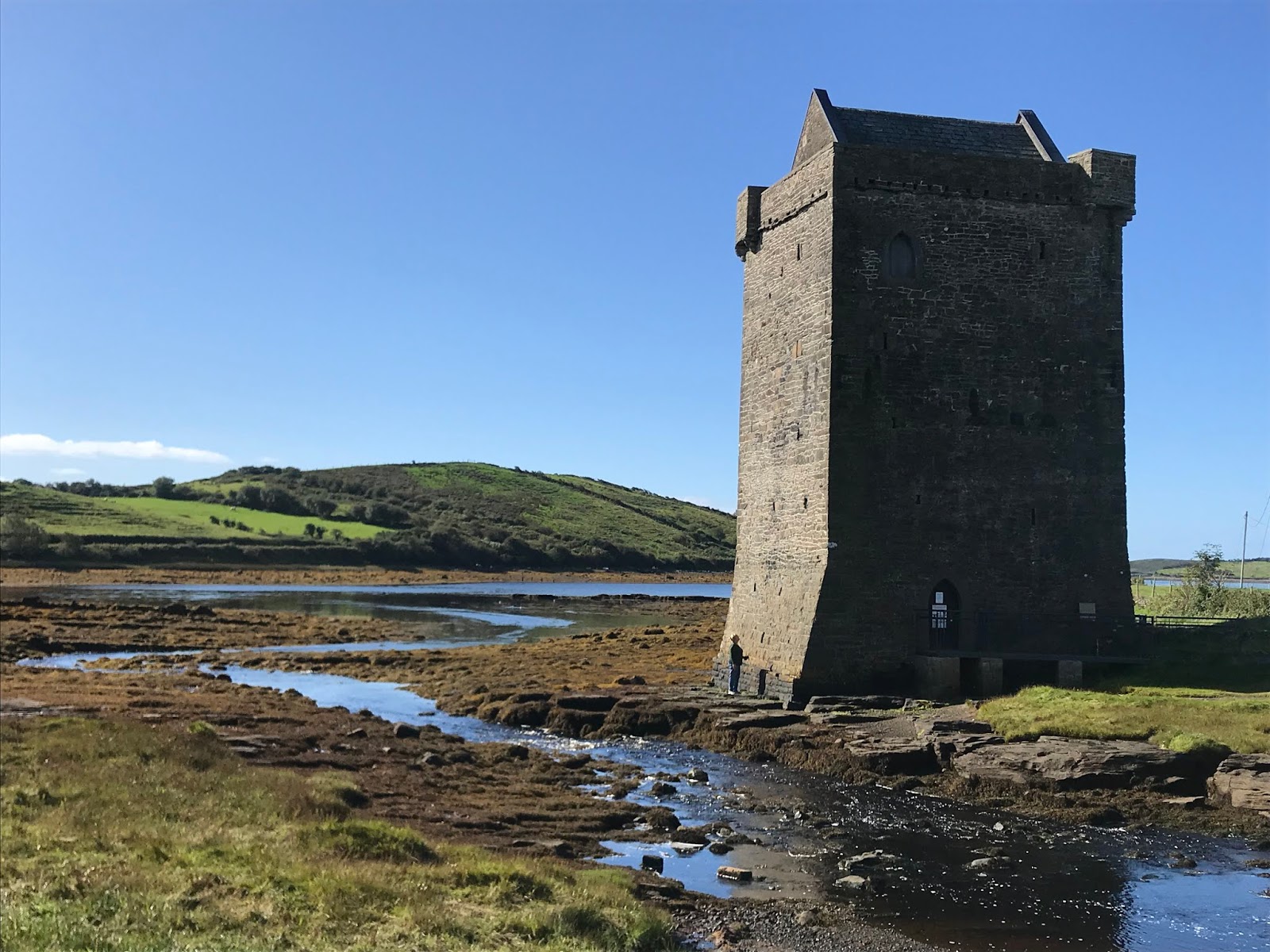
Rockfleet Castle, on Clew Bay, was built in the mid-sixteenth century, and is most famously associated with Gráinne Ní Mháille (Grace O'Malley), the 'pirate queen' and chieftain of the Clan O’Malley.  I have been in here once before, on a previous visit, as Kathy knew the lady who had the key, but now it is closed to the public.  
The living area was on the top floor, with magnificent views over the bay.  The "garderobe" (loo) was flushed twice daily by the tide.
According to legend, Grace O'Malley ran the mooring rope of her ship through the loophole in the south wall and tied it to her bed at night.
Local legend also has it that treasure once housed in the castle is now buried in an unknown location somewhere in the surrounding fields. If found, the individual who exhumed it is said to be met by the Headless Horseman resulting in dire consequences.  We didn't test this legend.
The lady in this picture told us there was an otter in the water by the castle, but we didn't see any.


Blackberries were growing in the hedgerows near the castle.  Yum.


Burrishoole Friary

Tuesday, 17th September, 2019.
Burrishoole Friary, or Abbey, near Westport, was founded for the Dominican order in 1469.  The Dominican friars first came to Ireland in 1224 (quite a long time ago.)


The community faced a threat of excommunication as permission had not been sought from the Pope for the foundation of the Abbey.  However, in 1486, the Pope instructed the Bishop of Tuam to forgive the friars.  Whew!  

The Abbey is built beside a tidal estuary.  Presumably the tide is out at the moment.


A babbling brook flowed into the estuary.  I'm not sure if my blogging skills are up to letting you hear the brook babble.


The estuary through an abbey window.


The estuary from the other side of the window.  As you can see, it was a sparkling day.

Westport

Tuesday, 17th September, 2019.

The next day was another beautiful blue-sky day, which everyone we met remarked on.  Kathy had to go to the dentist in Westport, so I wandered around taking photos.
Westport is on the edge of an Atlantic inlet, on Ireland’s west coast.  It is very popular with tourists because of the spectacular surrounding countryside.  The town itself is also very pretty.


There are huge baskets of flowers everywhere, and the town wins many "tidy towns" competitions.


Croagh Patrick to Connemara

Monday, 16th September, 2019.

We took a narrow winding road that led through some remote and beautiful country.


We stopped at a working farm/ restaurant/gift shop for a coffee, near Louisburgh, where Kathy knew the owners.


Occasionally we’d come around a bend and there would be a black-faced sheep wandering nonchalantly across the road.


Black-faced sheep.


Continuing on .....


Kathy liked this tree.

Erriff River.

Turf drying in the sun (when there was sun).

Our Lady of the Wayside Church had been designed to blend into the mountainous landscape.

Inside the church.  Kathy lights a candle.

Beneath the stained glass window, you could look out to the mountainous landscape.

The mountainous landscape.

Our first glimpse of Kylemore Abbey, across the water.

Kylemore Abbey, Connemara

Monday, 16th September, 2019.
When wealthy English doctor Mitchell Henry and his wife Margaret visited Connemara on their honeymoon in 1850, Margaret was "so charmed" with the area that Mitchell bought land and built a castle for her, completing it in 1868.  Sadly, Margaret died six years later, while holidaying in Egypt.


Feeling a bit peckish after all our mountainous driving, we had lunch in the Kylemore Abbey Mitchell’s Café.  Potato and dill soup, with a cheese and onion scone.  Yum.

The castle is approached by walking beside Pollacappul Lake, presenting the visitor with the stunning view of the building reflected in the calm water.  

On the hill above the abbey was a statue of Jesus.  Can you see it?  Not quite Rio de Janeiro, but still impressive.


Robin on the path.

After being owned by the Henry family, the castle had various owners until it was purchased by the Benedictine Nuns in 1920.

In 1923, the nuns established a flourishing school which operated until 2010.  Today the nuns continue with their daily life of work and prayer, and are the directors of the Kylemore Trust.  We were there on a Monday afternoon, well after the busy summer season, and there were still many visitors.


When the Benedictine nuns became the owners, the building was referred to as an abbey rather than a castle, but is still presented to visitors as it was in its heyday when owned by the Henry family.

View of the lake from the reception room.

Dining room.

After Margaret died, Mitchell built this church as a memorial chapel to his wife.


Within various parts of this church are marble columns from the four provinces of Ireland :  green from Connemara (Connaught), rose from Cork (Munster), black from Kilkenny (Leinster) and grey from Armagh (Ulster).

Kathy lights a candle.


While we were there, the sun had come out.  What a beautiful day!